
Judging the Judges
Public Support for Supreme Court Term Limits

Senators Peter Welch (D-Vermont) and Joe Manchin III (I-West Virginia) have introduced a constitutional amendment proposing 18-year term limits for Supreme Court justices. Bold? Absolutely. Necessary? According to most Americans, yes. This proposal arrives as public trust in the Supreme Court reaches all-time lows, driven by divisive rulings and growing concerns about its politicization. So, do Americans actually support such a sweeping reform? A July 2024 Change Research internal survey offers some revealing insights.
Broad Public Support for Change
Here’s the deal: most Americans are ready to see term limits for justices. According to the survey, 68% of respondents strongly or somewhat support the proposal, including a near-unanimous 90% of Democrats, 59% of independents, and 48% of Republicans. That’s a rare moment of agreement in today’s polarized political climate.
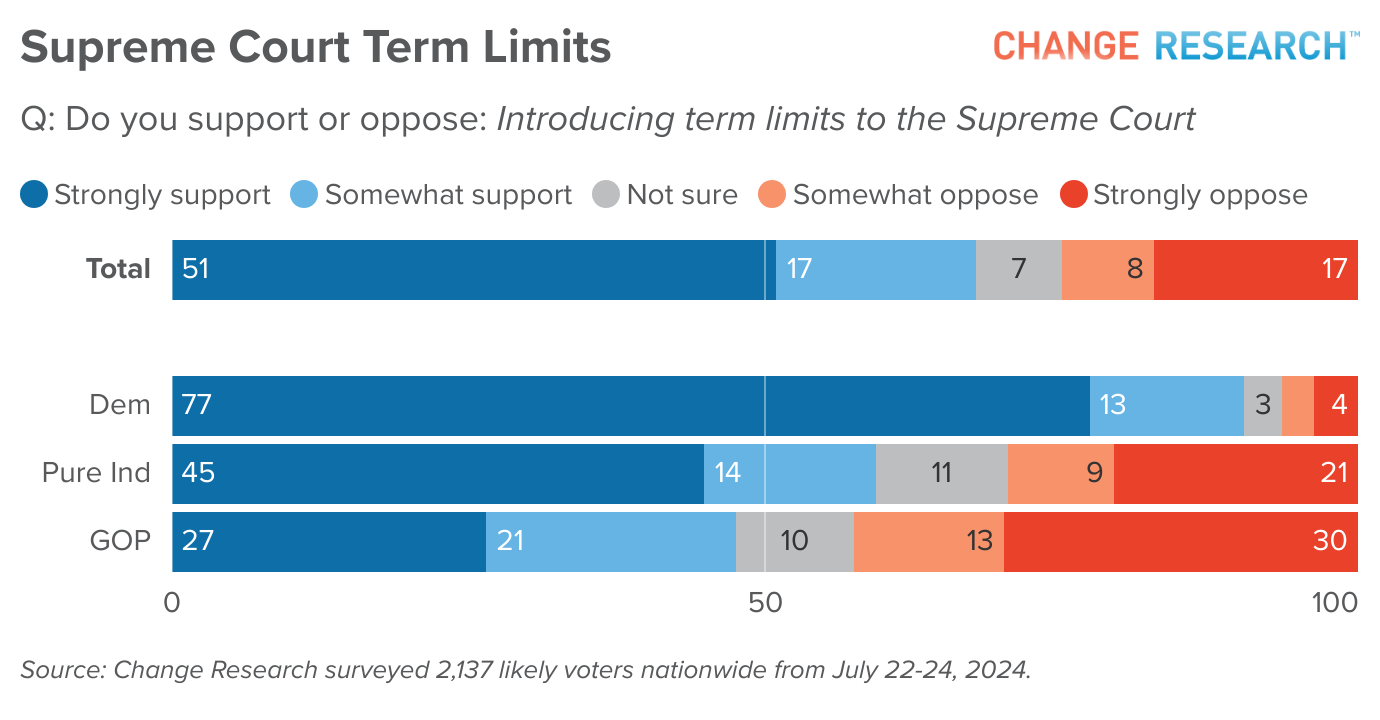
The push for term limits reflects deep concerns about how the Court functions. Senator Welch points to pivotal events, such as the Republican-led Senate's refusal to consider President Obama's nominee in 2016 and the rapid confirmation of three justices under President Trump. These maneuvers cemented a 6-3 conservative majority and, for many, eroded trust in the Court’s impartiality. Critics argue these actions have transformed the Supreme Court into a political battleground, a perception that term limits could help to mitigate.
What Term Limits Could Fix
The proposed 18-year term limits are designed to bring predictability—and sanity—back to the process. Under the Welch-Manchin plan, every president would nominate two justices per term, spreading out appointments and dialing down the life-or-death stakes of each vacancy. Senator Manchin argues that this would keep the Court aligned with modern societal values, ensuring fresh perspectives from justices who haven’t spent three decades on the bench.
Manchin puts it bluntly: term limits would end the “whims and wishes” of partisan meddling. The goal, he says, is to ensure justices serve the people, not political agendas. It’s a lofty aspiration, but one that resonates with a public increasingly wary of entrenched power.
Beyond Term Limits: Ethics and Accountability
It doesn’t stop at term limits. The survey also reveals overwhelming support for enforceable ethics rules for Supreme Court justices. Seventy-seven percent of Americans—yes, you read that right—want justices held to the same ethical standards as other federal judges. Among Democrats, support reaches 96%, while 61% of Republicans are also on board.
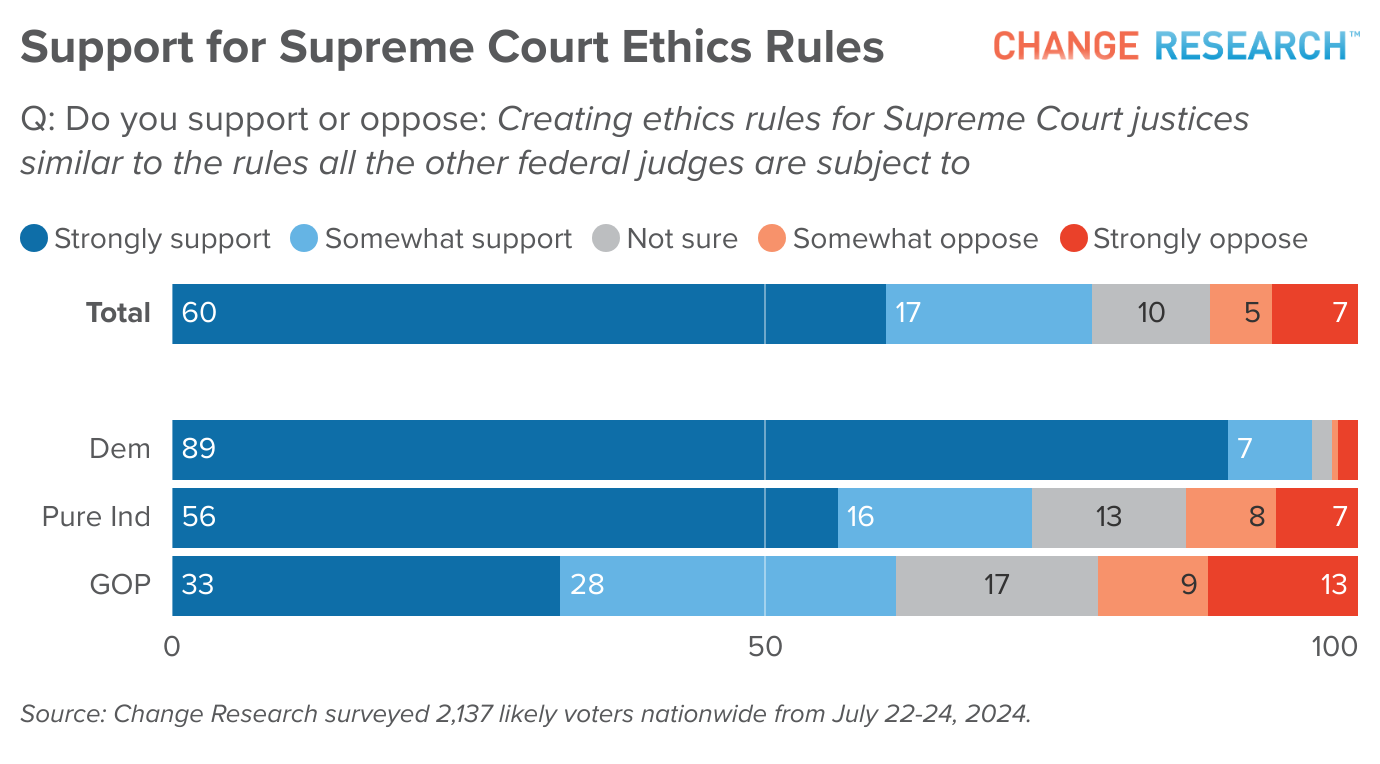
Recent ethics scandals involving justices have only fueled calls for accountability. Reform advocates argue that implementing ethics rules alongside term limits is critical for rebuilding trust in the Court.
The Uphill Battle for Reform
Here’s the catch: constitutional amendments are notoriously hard to pass. The proposal needs a two-thirds majority in both the House and Senate, followed by ratification from three-fourths of the states. To put that in perspective, only 27 amendments have successfully cleared this gauntlet in U.S. history.
But Welch and Manchin aren’t naive. They know the odds are slim. Still, they see this amendment as a starting point—a way to ignite a national debate about the Court’s future. And let’s be honest: if the proposal gets people talking, it’s already halfway to success.
A Court at a Crossroads
Public trust in the Supreme Court is very low. Americans support term limits, ethics rules, and greater accountability. While the road to reform is steep, the conversation it sparks is vital. Restoring the Court’s credibility won’t happen overnight, but the first step is clear: acknowledging the need for change.
The question now is whether lawmakers will rise to the occasion or let this moment pass. One thing is certain: the public’s patience is wearing thin. The time to act is now—because America deserves a Supreme Court that works for the people, not against them.

Sumati joined Change Research in November 2021, contributing her expertise in data analytics and social advocacy. Her previous experience encompasses roles such as Coordinator for Research and Data Science at Phi Theta Kappa International Honor Society and Director of Academic IT at Tougaloo College, a historically black college in Mississippi. Additionally, she serves as co-chair of the Mississippi Alliance for Change. Shaped by her rich cultural heritage—her father an Indian immigrant who inspired her passion for politics, and her mother a dedicated Black public school educator who fostered her advocacy interests—Sumati brings a uniquely diverse lens to her work. Sumati holds an MBA from Walden University, a Bachelors in Software Engineering from the University of Southern Mississippi, and is a Fall 2021 Arena Academy–digital track graduate. Sumati enjoys life in her hometown in Mississippi, where she lives with her family and a lively trio of pets.